One of the most discouraging replies a founder can get from an investor is also one of the most common: “Please submit through our application.” You spent time researching the partner, found a legitimate professional route, sent a concise note, and finally received a reply. Now the investor points you toward a web form. It feels like the conversation ended the moment it began.
I understand why founders interpret it that way. A formal application looks impersonal. It asks for information the investor could theoretically find in your deck. And there are funds where the portal really is just the normal cold-inbound channel, with no guarantee anyone will review a submission quickly.
But I've learned not to treat the existence of a form as evidence of rejection. Sometimes the form is the firm's way of advancing the conversation. The important question is what happens before it, how the investor directed you there, and whether you preserve that context afterward.
The FoundersEdge progression changed how I think about applications
In a real outreach sequence involving FoundersEdge, the founder had reached the firm through relevant initial contact. A general partner directed the team to the official application route. The founder later confirmed completing the requested submission. Communication continued in the existing context. Eventually there was an in-person Boston meeting with the GP, and a follow-up request for a product demonstration video.
That's a real progression across several touchpoints. It doesn't mean the application automatically created the meeting or that the fund made a commitment. The sequence shows something narrower, but more useful: the formal submission was one stage of a live relationship, not a dead end by definition.
I can't share the private email chain as a screenshot, and founders don't need it to learn the method. The operating lesson is that you should follow the investor's process while maintaining the context that makes your submission different from an anonymous, context-free form entry.
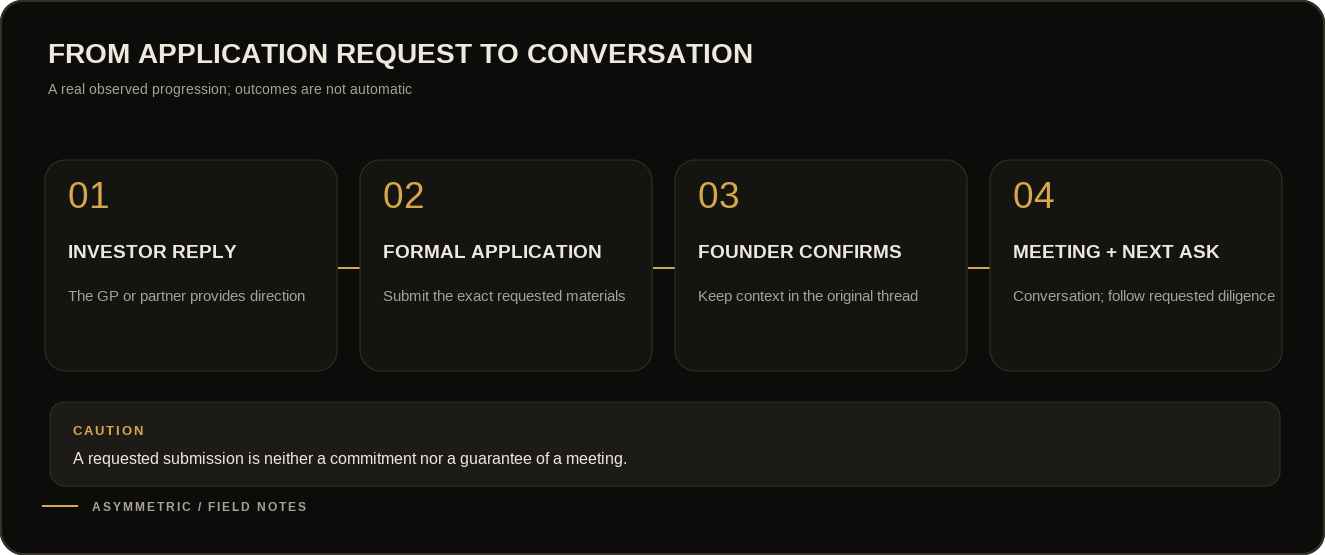
What I would do after the GP says “use the portal”
First, verify the actual portal. Use the fund's official website or a link supplied by the investor. There are plenty of generic contact pages that have nothing to do with investment intake. Don't send a founder's data room into a third-party directory because it resembles a fund application.
Second, submit exactly what the portal requests. If the fund requires a deck, specific round details, customer traction, and founder background, prepare a clean set of consistent answers. Do not invent a lead investor, imply a term sheet, or inflate a commercial metric to get through the screening questions. If information is genuinely unavailable, respond according to the form's instructions rather than filling it with guesses.
Third, record the submission. I want to know the actual fund and route, the submission date, any confirmation number or acknowledgement, the materials provided, and who originally asked for the application. A single firm record is enough. This prevents the founder from resubmitting through another route because they forgot the first one.
Fourth, reply in the original conversation in plain language. An illustrative follow-up could be: “Thanks, Alex. I completed the application you pointed us to and included the current deck and revenue figures. Happy to share a product walkthrough if useful. Appreciate you directing me to the right process.” Short, respectful, accurate. No attempt to force a meeting five minutes after the form was submitted.
Fifth, follow the next legitimate trigger. Maybe the fund asks for a product demo. Maybe an associate requests a financial model. Maybe a partner introduces another team member. Or maybe the firm provides a clear pass or a lead-investor condition. Each state requires a different response.
Why a formal route can matter even when you already know someone
It is tempting to say, “Why would I submit through the portal if a partner is already responding to me?” Because a partner's personal interest and a firm's internal process are not the same thing. Some firms need the opportunity entered into a shared deal-flow system so the team can manage screening, conflicts, diligence, and internal decision-making.
I don't advise founders to bypass that. If an investor asks for a standard process, follow it and keep the referring context accurate. If you were referred by a partner, the form should not imply the partner endorsed the deal unless they actually did. You can say the partner directed you to the intake route if that is true.
A form isn't a meeting. A form isn't a rejection either. It's a step, and your job is to know which step came before it and what step could reasonably come next.
Framework taught the same lesson from a different direction
We also worked through a Framework-related route where partner-connected context led toward a formal deal-flow path, then an investment-team introduction and booking link. That's evidence of process movement. It is not evidence that an investment was committed, or even that a meeting was necessarily held based solely on the link.
A subsequent financing-structure or lead-investor condition affected whether the opportunity could progress. That's exactly the sort of information a founder should capture rather than interpret as generic disinterest. It may mean the fund is not the right lead for this round. Or that a new condition would need to be satisfied before a later conversation is worthwhile. The correct action may be to pursue investors who can lead, then update the conditional participant if the relevant facts change.
The lesson is not “applications always work.” The lesson is that a venture firm is an organization with several routes and internal stages. You need to know which stage you're in. The companion article, the six ways into one VC firm, explains the broader model.
A small operating ledger prevents a lot of awkward follow-up
I would keep a simple record for each fund. It doesn't need to be a dashboard. A careful spreadsheet is fine.
| Field | Why it matters |
|---|---|
| Formal route | Records the exact, legitimate intake URL or address. |
| Referral context | Shows which investor asked for the submission, if anyone. |
| Date and acknowledgement | Prevents duplicate applications and premature follow-up. |
| Materials submitted | Shows which version of the deck and metrics the firm received. |
| Investor request | Distinguishes a demo ask from a calendar link or generic acknowledgement. |
| Condition or objection | Captures stage, thesis, lead-investor, or financing restrictions. |
| Next appropriate action | Gives the founder a clear decision instead of endless reminders. |
On the website I prefer not to show founders actual private pipeline screenshots, so the illustrated workflow explains the pattern without exposing confidential correspondence. The process is what matters.
A practical follow-up system that respects the investor
If the investor requested a submission and you completed it, a short acknowledgement is usually appropriate. After that, don't assume a fixed sequence of aggressive daily reminders is helpful. Follow their stated process and timing. If they give an application status portal, use it. If they request more materials, send them accurately and promptly. If the fund passes, record the reason and stop inappropriate further outreach.
If a later traction milestone genuinely changes the investment case, a concise update may be appropriate, particularly when the investor invited one. The content should address a real objection. “Just checking in” has little information. “Since we spoke, the pilot expanded into a paid annual contract and the retention data is now available” is meaningfully different, assuming it's true.
We use the same distinction in investor email writing: each message has a specific job. A first approach earns relevance. A form confirmation preserves context. A later update brings new information. A meeting-coordination note makes the next action easy. I explain the concise-message structure in Stop Writing Investor Emails Like Pitch Decks.
The application is part of the funnel, not the whole funnel
A good founder may need to navigate direct partner contact, investment-team routing, verified deal-flow inboxes, official applications, introductions, and event connections. An investor reply can change which route is correct. That's why blasting all six routes at once is usually a bad idea.
When we build an Investor Pipeline for a founder, we're not simply writing one email and waiting. We're researching qualified firms, choosing appropriate routes, preserving founder approvals, tracking responses, completing formal intake where it is actually requested, and keeping follow-up tied to what happened. If you want to see whether that operating process fits your current round, I'd be happy to look at it with you.
You can do the same thing yourself for your first set of investor targets. Start small. Create one record per firm. Keep the thread intact. Be precise about what the investor asked for. Track the status honestly, not optimistically.
An official application isn't glamorous. Neither is documenting a submission date. But those are the unglamorous details that stop fundraising from becoming a chaos machine. A founder who knows exactly what happened with each qualified firm can make far better decisions about where to spend the next week.
Case-study note: this article summarizes supported workflow stages from actual outreach. It does not reproduce private correspondence, promise that applications lead to meetings, or imply investment commitments. All sample follow-up language is illustrative.