There's a particular kind of fundraising frustration I've watched for years. A founder buys an expensive conference ticket, books a flight, arrives with a perfectly good pitch, and spends half the event figuring out which people in the room are actually investors. By the time they identify a relevant partner, that person is already heading into another conversation. The founder leaves with a stack of business cards and a vague promise to follow up.
I've hosted curated founder events in New York, including private panels where the most interesting conversations happened before the audience ever sat down. What those experiences taught me was that the real advantage isn't just access to an event. It's understanding the people, the context, and the next sensible conversation in advance.
For an investor conference, I now think of the published investor roster as the beginning of a targeted GTM campaign. The event date is a deadline. The roster is a list of hypotheses. The actual work is qualification and routing.
Stop treating the attendee roster like a mailing list
The first mistake is assuming that every name on a published event page is a qualified target. A firm could invest in software, but at a later stage. A partner might be attending to speak on a panel while their current fund is no longer deploying in your category. A principal may focus on fintech when you're raising for developer infrastructure.
For the November 2026 New York Venture Summit preparation, I treated the event information as a sequence of research tasks. Before writing any message, I wanted to know whether an investor's name was officially published, whether their role and firm were current, and whether the firm's mandate fit the actual company. Then I ranked the plausible conversations rather than trying to contact everyone.
That matters because a line like “I saw you'll be at the event” is only helpful when it's true. If participation isn't verified, don't imply it. You can still approach the investor on the strength of their thesis, without forcing event personalization.
The 14-day calendar I would use
A conference gives you a natural working horizon. You don't need a complicated automation system. You need enough time for a relevant invitation, a thoughtful reply, and a realistic scheduling window.
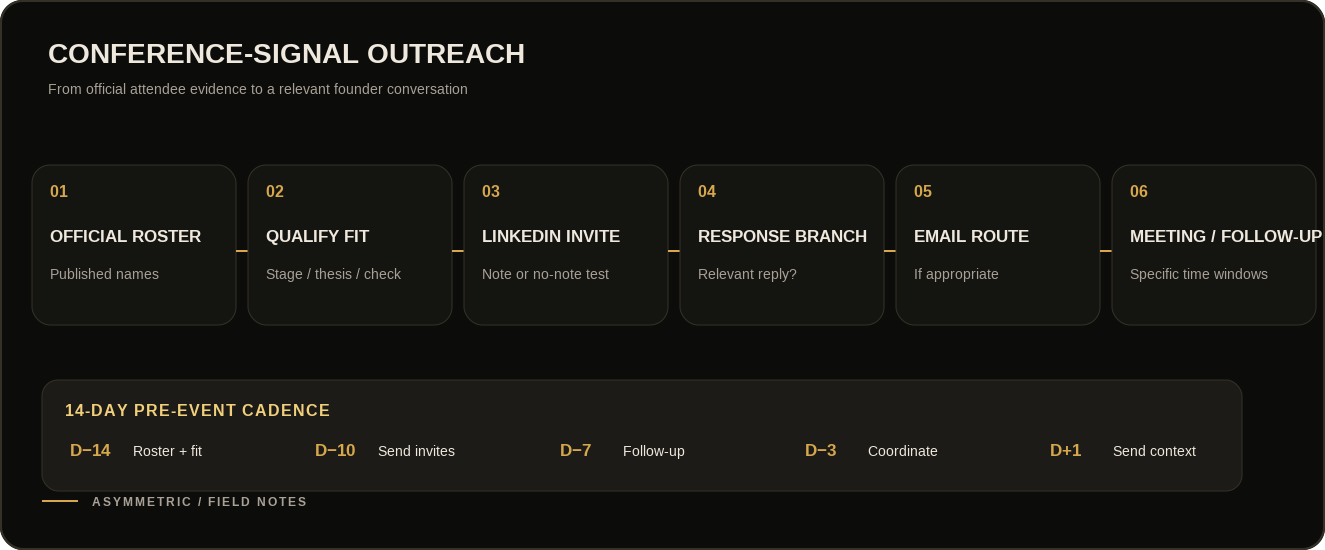
Around two weeks out: I review the official speaker or investor roster and confirm that the people actually belong to relevant firms. Firm pages, official investment announcements, and their own professional profiles help establish stage, check-size, category, and geography. The goal is a prioritized shortlist, not maximal coverage.
Ten days out: I start a modest number of LinkedIn invitations. Each invite is an experiment in relevance. I don't paste a mini pitch deck into the connection note. In fact, we tested both including and excluding a note, because there are legitimate reasons each might work.
Seven days out: For accepted connections, I send a concise one-to-one follow-up that states who the company serves, the relevant investment angle, and what I'd like to discuss. It sounds like a human. It is not a four-paragraph company biography. Non-responders are not automatically a reason to start messaging every person at the firm.
Several days out: When someone expresses real interest, I propose a specific 15-minute meeting window. That is easier to answer than “Would love to connect sometime.” If email is an appropriate professional continuation path, I use it with the existing context, not as a disguised second cold approach.
After the event: I send whatever was requested: a deck, a product walkthrough, a diligence item, or a brief update. If there was no interaction, I don't pretend we met.
What happened when we tested LinkedIn notes
Our historical campaign snapshot offered an instructive contrast. With an invitation note, the connection acceptance rate was 13.3%. Without the note, acceptance was 22.6%. If all you watched was the connection metric, you would call the no-note approach the winner.
But the total reply rate across channels was 13.3% with a note versus 3.2% without one. In other words, in this snapshot the no-note cohort accepted more invitations, while the note cohort generated roughly four times the reply rate.
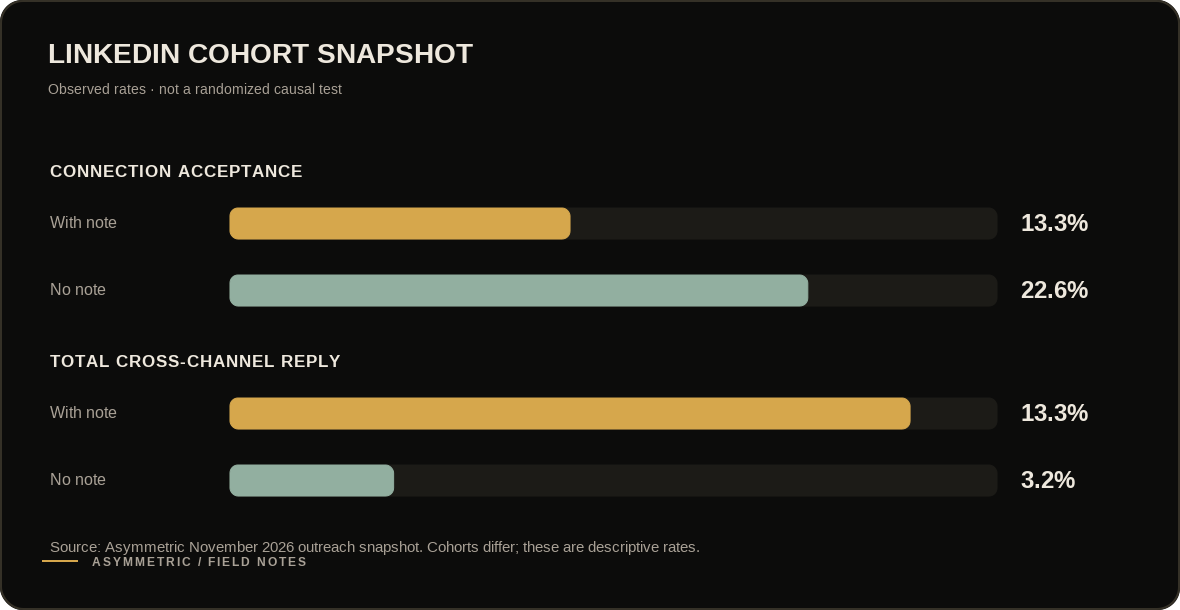
That is an interesting result, but not a final verdict. The cohorts were not a perfectly randomized, isolated test. The lists and sequencing conditions can differ. Acceptance is measured against invitations sent; the reply metric is a different outcome. I would not tell a founder “always include a note” based on these percentages.
What I would tell them is to decide which behavior matters. Do you want more LinkedIn connections? Or more substantive investor conversations? Then run a clean test against your own investor-fit cohorts and optimize for the latter.
The event is a reason to begin the conversation. It is not evidence that the investor is interested in your round.
The first message should have one job
Here's a natural follow-up to an accepted invitation, with fictional specifics: “Hi Alex, saw your team focuses on early enterprise infrastructure. We're raising a seed round for an AI workforce that handles routine IT execution. I'll be around the summit next week. Would a quick 15-minute conversation be relevant, or is there someone else on your team who covers this?”
Notice what isn't in there. No exaggerated flattery, no unsolicited market-size essay, no “I'd love to pick your brain,” and no invented claim that you already know them. The ask also leaves room for a better internal contact.
For a partner who has clearly signaled interest, I might offer two windows: “I can do Tuesday at 10:30 or Wednesday at 2:00. Would either be convenient?” Those times are examples, not a claim about a specific scheduled meeting. When the answer is no, respect it and move on.
You also need a firm-level plan
A conference encounter is only one route into a fund. If the appropriate person is unavailable, the alternative may be an investment-team member, an official intake portal, or a relevant warm introduction. The work is to know which option is legitimate and which one makes sense next, not to run them all concurrently.
This is why the six-route framework is so useful. It changes your mental model from “I need to meet somebody from that fund” to “I need to determine the next appropriate path for that firm.”
A separate real event-related sequence of ours involved an investment-team professional at a US venture firm. The interaction led to a founder conversation and materials reviewed internally. It was not necessarily produced by the same NYVS note/no-note test and should not be combined with that data. I like the example because it proves a more modest, useful point: an investment-team contact can move a real evaluation process forward without being the final signing partner.
Build an event shortlist that actually helps the founder
I use a simple hierarchy. Priority A means the firm's mandate is an unusually clear fit, a specific partner or investment-team member is identifiable, and there is a timely, honest reason to reach out. Priority B means the firm fits but the route or deployment timing needs work. Priority C might be worth a later update, but not immediate conference outreach.
The practical research fields are few:
- Official participation source: Where did we verify the event connection?
- Mandate: Stage, sector, geography, and likely check range.
- Person: Why this particular investor, not simply the firm?
- Route: LinkedIn invite, relevant professional email, official application, or an introduction.
- Conversation state: Invitation sent, accepted, replied, meeting proposed, held, declined, or follow-up pending.
- Next action: The single appropriate step, not an automatic barrage.
For events with hundreds of names, that can become a serious operational assignment. If you're a founder preparing a round while managing a product and team, I can show you how we operate this as an Investor Pipeline rather than leaving you with another giant spreadsheet.
The part founders underestimate: after the conference
Let's say you have three good conversations. It's tempting to mark the event a success and move on. But the outcome depends on what happens next. Did you send the materials requested? Did you log the objection? Did you ask when to reconnect? Did the investor mention a more relevant partner? Did the company hit a new milestone one month later that would change the conversation?
I want the event context stored in the same firm record as the original research and outreach. Then a later traction update can refer to the actual conversation. If a partner asks for a formal application, the response stays connected to the original thread. If the team passes, the fund isn't automatically reintroduced to the same pitch by another channel.
That's what it means to treat investor relationships like an account-based operating process. The conference can accelerate the process. It shouldn't replace it.
A better measure of event ROI
Don't judge the conference only by contacts added or messages sent. I would review the shortlist quality, thoughtful replies, qualified meetings actually held, requested materials, and concrete next actions. I also look at the insights we learned: a repeated objection, an adjacent sector thesis, a financing condition, a team member who handles a more relevant category.
Those inputs improve the next outreach wave even when an event itself produces no immediate commitment. And that's the real opportunity: relevant investor conversations can begin well before the founder walks through the conference doors.
If you would rather spend that prep time on your company, we can discuss whether our managed Investor Pipeline fits your fundraising timeline. Either way, start with the official roster, verify real investor fit, and make the next message worth answering.
Source: Asymmetric investor outreach campaign observations through November 2026. Cohort results are observational, not guarantees or proof of causation. These examples do not imply investor financing outcomes.