I understand why founders write long investor emails. You've spent years building the company. You know the product, the market, the customer, the team, the unit economics, and what your last customer said about the problem. After enough silence from investors, it feels rational to explain everything in the first message so they can't possibly miss how good the company is.
The result is usually an email that reads like somebody pasted the first eight slides of the pitch deck into Gmail. A market-size claim, three product features, an impressive résumé, six metrics, a paragraph about the future of AI, and a request for 30 minutes. Sometimes the only thing missing is a slide number.
I stopped treating the first email like a presentation. I think of it as the first ten seconds of a qualified conversation. Its job is much smaller: help the right investor recognize why this company might belong in their world, and make a reasonable next step easy to answer.
One message can be truthful and still be badly structured
Here's a fictional first email in miniature: “Hi Alex, we're disrupting enterprise IT with a patented AI platform for a trillion-dollar market, our team includes outstanding operators, we have a category-defining roadmap and are targeting significant ARR growth over the next three years. We're raising seed. Can I have 30 minutes?”
Every claim might be defensible. But the investor has to do the work of figuring out who the customer is, what's actually changed, why it fits their thesis, and what would happen in the meeting.
A better message compresses those facts into a useful signal. I use four parts: Signal → Category → Investor Relevance → Ask. That's not a rigid template where each part needs its own paragraph. Sometimes all four fit comfortably into three sentences.
The three opening angles we've actually explored
1. Traction-first
This is especially useful when the company has a commercially relevant number for its stage and sector. The number should be real, current, and comparable. An enterprise software company with $250K ARR may be early for one fund and interesting to another depending on fund size, stage, customer type and market. Context matters.
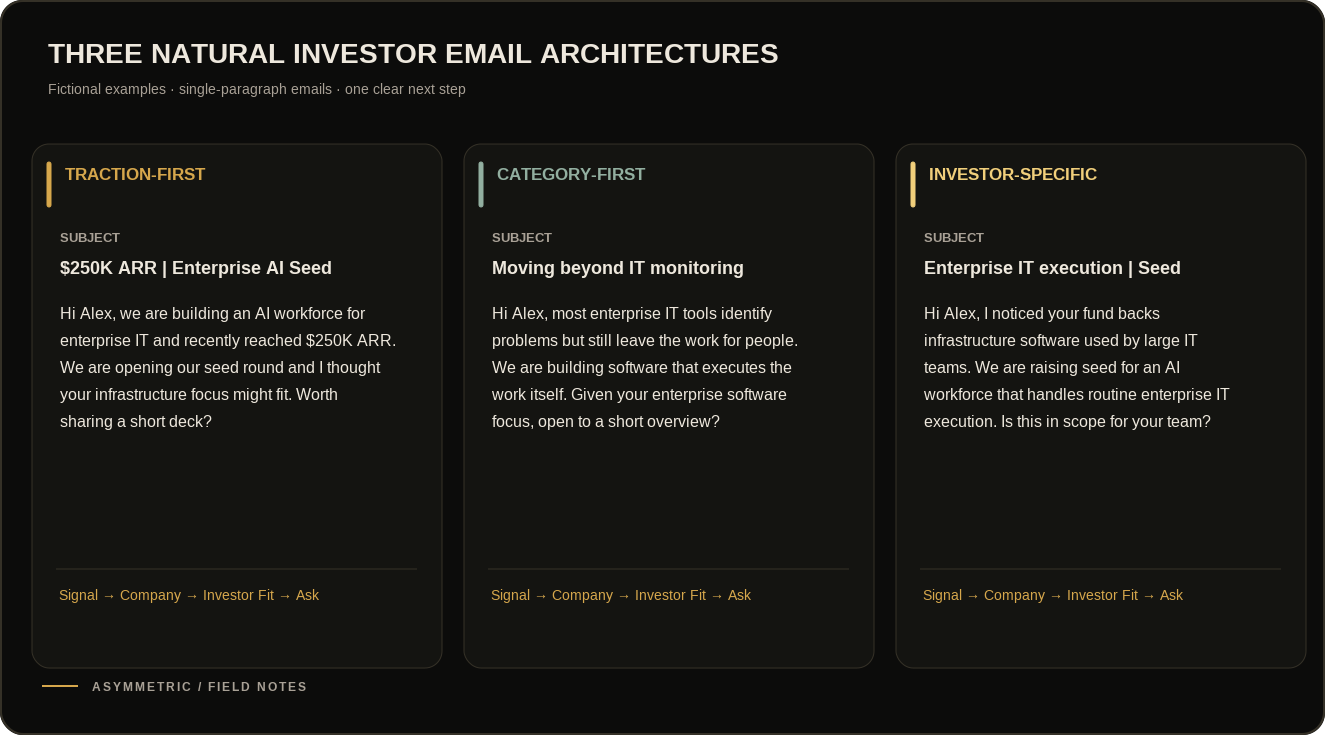
Illustrative subject: $250K ARR | Enterprise AI Seed.
Illustrative email, deliberately compact: “Hi Alex, we're building an AI workforce for enterprise IT and have reached $250K ARR. We're opening a seed round, and your investments in enterprise infrastructure looked like a relevant fit. Would it be useful if I sent a short deck?”
That's not a claim about any named client's ARR. It demonstrates a structure: a relevant signal, a precise category, actual investor fit, and a small ask. If the company has no revenue yet, don't pretend it does. Lead with an equally real proof point such as paid pilots, retention, high-quality technical validation or a specific distribution insight.
2. Category-first
A category-first message is more useful when the product's difference is the strongest reason an investor should care. In enterprise IT, for example, the shift can be explained without sounding like an AI glossary: traditional systems identify issues and route tickets; an emerging class of software attempts to execute the work itself. The language makes the economic problem legible: how much expensive human effort still sits between detecting a problem and resolving it?
A compact fictional example: “Hi Alex, most enterprise IT software tells teams what's broken but leaves the actual work to engineers. We're building software that handles routine IT execution end to end, and we're opening a seed round. Since your team invests in infrastructure software, would this be in scope for a short overview?”
Notice that the first sentence explains a difference in how the world works. It does not open with “revolutionizing,” “best-in-class,” or invented category leadership. The message leaves room for a conversation, instead of trying to prove every aspect of the company immediately.
3. Investor-thesis-first
This angle begins with genuine investor-specific relevance: a published sector thesis, a current investment, a market the partner has publicly discussed, or an operator background that makes the company unusually relevant. The observation has to be specific enough that it wouldn't fit 300 different firms.
Example: “Hi Alex, I noticed your team's recent focus on the infrastructure behind enterprise AI adoption. We're raising seed for an AI workforce that executes routine IT work rather than just generating recommendations. Is this a category your team is evaluating, or would a different partner be a better person to approach?”
The second half of that sentence is often underrated. A good prospecting message sometimes earns the correct internal route rather than the meeting itself. That's why I connect email copy to firm-level contact-route research. A relevant company sent to the wrong person is still poorly targeted.
What our historical campaigns actually showed
We ran different outreach angles over historical campaign cohorts. A traction-first cohort recorded 26.7% opens, 10.0% clicks, and 0.0% replies. A founder/team-first cohort recorded 43.3% opens, 10.0% clicks, and 3.3% replies. A contrarian category-first cohort recorded 39.1% opens, 8.7% clicks, and 6.5% replies.
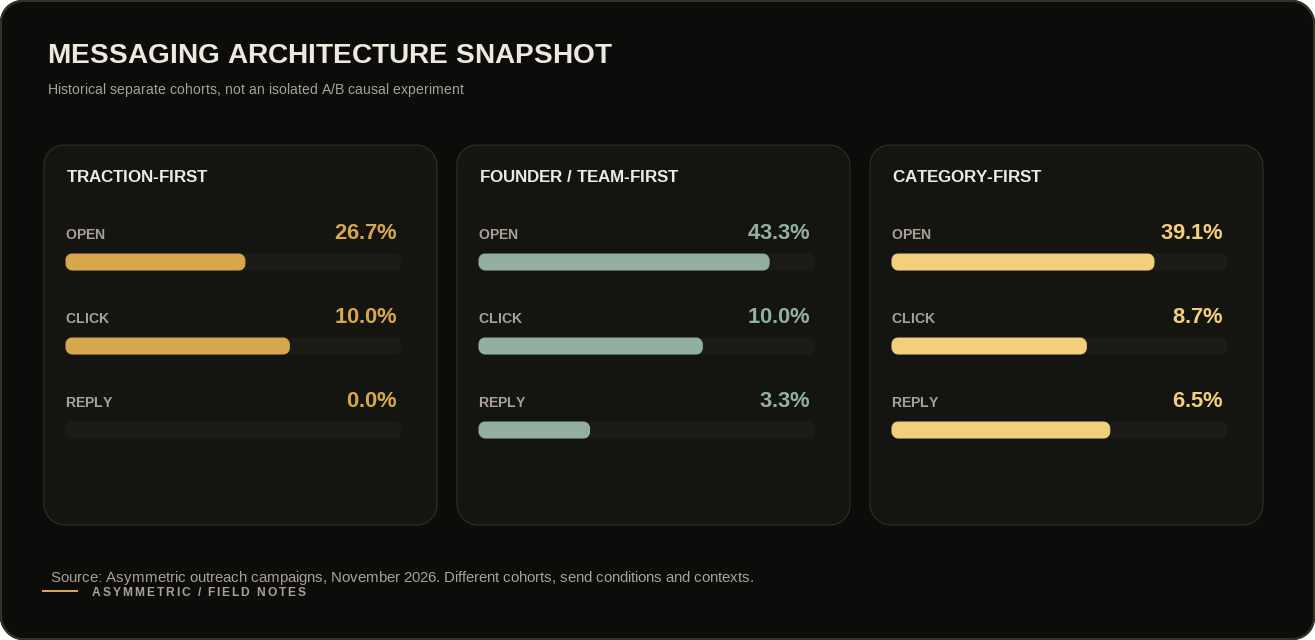
Those percentages are useful observations, not a magic-copy formula. The cohorts differed in time, audiences and other conditions. Opens can be affected by email privacy features and are imperfect attention indicators. Clicks show activity but not necessarily investment interest. Replies include more than positive responses. What I care about is whether a response starts a legitimate next step with a qualified investor.
The useful surprise is that the angle with the largest open rate did not have the strongest reply rate in that snapshot. I would be very careful about optimizing a fundraising process only for opens.
The subject and first line earn a look. The company and the ask earn the conversation.
Shorter doesn't mean less sophisticated
A short email works when all the hard thinking happened before the draft. You need to know what the firm invests in, how the company compares to its portfolio, and which proof point changes the conversation at the current stage. Then you can cut almost everything that isn't directly useful.
I like to draft the message as if the investor will read it on a phone, between meetings, with no extra context. The message should survive that situation. It can link to a deck after the investor asks for one or when a relevant formal process calls for it. It shouldn't make the reader parse your entire data room in email form.
This is also why I don't like exaggerated personalization. “I've been following your incredible investment journey” tells the investor almost nothing. “Your team backed two tools selling into enterprise IT, and we're solving an adjacent execution problem” is useful if it is true. Don't guess at their portfolio just to sound personal.
The ask changes depending on the route
A general partner with a matching mandate might reasonably receive a meeting ask. An investment-team member might be better positioned to tell you whether the fund is currently evaluating that category. A shared deal-flow inbox might require a structured overview with the information the firm requests. A warm introduction needs a short, forwardable company description.
There is no reason for every route to share the same “let's grab 30 minutes” CTA. In our actual workflow, we've had partners direct founders toward an application and investment-team members request materials. The best response was to move the process forward in the requested way, not insist on the original meeting ask.
I also favor specific time windows after positive engagement. Asking an interested investor “Would Tuesday at 10:30 or Thursday at 2 work for 15 minutes?” removes friction. Those times are examples, not a promise of availability. Cold contacts who haven't engaged yet should not be burdened with an unsolicited scheduling link in the first message.
A simple editing process any founder can use
Here's what I'd do before sending the next 20 investor emails. First, write a two-sentence version of the company: customer, problem, solution, and differentiation. Second, list three possible proof points: traction, team-market fit, and category/economic thesis. Third, research ten genuinely compatible firms. Fourth, write one message for each opening angle without changing the underlying truth. Fifth, inspect which type of qualified investor actually responds and what their objections tell you.
Don't rewrite the subject, body, target list, sender and ask all at once and then pretend you've isolated what caused the result. If you want to know whether subject-line framing matters, keep the rest of the message stable and test that separately. I laid out the logic in the investor subject-line experiment article.
When a reply arrives, capture its meaning. A request for a deck is not the same as a meeting. An invitation to submit a portal is not necessarily a pass. A real objection about stage, proof or financing structure can help you change the next wave.
The email is only one layer of the pipeline
You can do this yourself. You don't need permission to write a better first email. But if each investor firm needs route research, relevant copy, sequence timing, a follow-up decision, and later traction updates, it becomes its own ongoing operation. I built Asymmetric's Investor Pipeline to manage that work in coordination with the founder. If you're looking for someone to build and operate that investor outreach process with you, we can talk through the current round and see whether there's a fit.
Until then, here's the change I'd make immediately: delete the paragraph you're least willing to delete. Then ask whether the first two sentences give the right investor enough reason to care. The investor can read the full pitch deck after they decide they want it.
Source: Asymmetric investor outreach observations, November 2026. Email rates are based on sent messages; separate historical cohorts should not be interpreted as isolated causal tests. Sample emails are fictional illustrations.