A founder can spend a year building something genuinely impressive, then spend the next three months trying to figure out which person at a venture fund should receive the deck. I kept seeing that contrast while hosting founder and investor rooms in New York. The conversations inside those rooms were specific: customer acquisition, enterprise sales, runway, a product that suddenly started working. But when the discussion moved to fundraising, the plan often collapsed into some variation of, “Do you know a partner at this fund?”
I've hosted founder panels and private gatherings at UBS, worked alongside sponsors including MongoDB Ventures, and met a lot of capable operators who could explain their businesses in painful detail. What surprised me wasn't how hard fundraising was. It was how little structure there was around the work of getting the first investor conversation. Random conference tickets. A spreadsheet of firm names. A dozen warm-introduction requests with no clear reason for the recipient to make the introduction.
Founders were accidentally running two companies: their startup and their fundraise. The second company had no owner, no process, and usually no reliable follow-up.

I came from performance marketing and GTM, where we wouldn't confuse a list of accounts with a working distribution system. A qualified enterprise account might have a buyer, a champion, an inbound route, a referral, and an event connection. All of those routes belong to the same account. Yet founders often treat a venture firm as one email address. If that address doesn't reply, the entire firm becomes “unresponsive.”
That is the mistake I want to fix. Not by advising founders to send six pitches to the same fund. Quite the opposite. By researching the possible paths, choosing the right one, and preserving one coordinated history.
A fund is a firm, not a name in your spreadsheet
Before the routes, a qualification rule. I don't pursue a firm simply because it invested in a company with the word “AI” in its description. I want to know whether the stage, sector, initial check size, geography, and current deployment context make a conversation plausible. If those are wrong, adding contacts creates more work, not better odds.
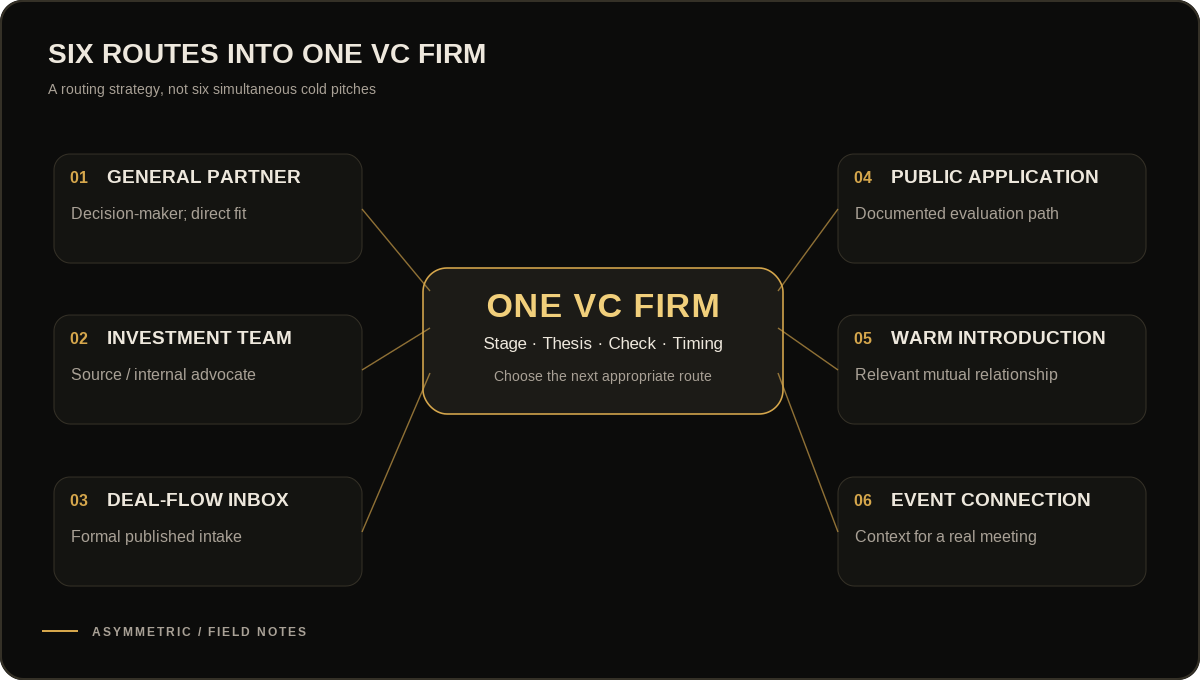
Route 1: The general partner or managing partner
If a particular partner has a demonstrable investment thesis matching the company, that person is often the cleanest starting point. The work is in the word demonstrable. Look at portfolio companies, the partner's own writing, actual investments, and what the current fund is likely to do. A firm's broad marketing language is weaker evidence than a partner's real decisions.
A sensible initial email could be as straightforward as: “Hi Alex, we're building an AI workforce for enterprise IT and opening our seed round. We recently reached $250K ARR and your infrastructure investments looked relevant. Would it make sense to share a brief deck?” The metrics and investment thesis here are illustrative, not a report of a named company's performance. The real email should use figures you can defend and a fit observation you verified.
The reply is not always “yes, here's my calendar.” It might be “send the deck,” a referral to an associate, a request to use the official portal, a timing objection, or a pass. All of those tell you what to do next. In one historical outreach cohort we observed a 6.5% reply rate for a category-first approach, compared with 3.3% for a founder/team-first approach and 0% for a traction-first approach. These were different campaign cohorts, not a randomized proof that one message style wins. They were enough to remind me that relevance has to be tested rather than assumed.
Route 2: A principal, associate, or other investment-team member
Founders sometimes dismiss investment-team professionals because they are not the final decision-maker. That's a mistake. These people source, research, compare, and help move opportunities inside a firm. A strong principal can be precisely the right first conversation. The goal is not to pretend they can personally commit a fund. It's to give them a company they can credibly bring to the right partner.
We saw that in a real event-related outreach sequence at a US venture firm. A relevant professional connection led to a founder conversation, and materials were subsequently reviewed internally. That's a meaningful process step. It is not an investment commitment and I wouldn't describe it that way. The useful lesson is to respect the internal routing work instead of treating every non-partner reply as a detour.
When someone says they will circulate the materials, ask what would be useful for their colleagues to evaluate, send precisely that, and record the next expected action. You are helping someone make the second pitch inside their firm. I wrote more about how conference context can start those interactions in the investor event-signal playbook.
Route 3: A verified deal-flow inbox
Some funds have a public address explicitly intended for investment opportunities. That is very different from a generic info@ mailbox, a media-contact form, or an address guessed from someone's name. I distinguish published investment intake from generic corporate contact and log the source so we know why a route is legitimate.
An official deal-flow inbox can be exactly the correct path after a partner asks a founder to submit there. The partner context matters. If a senior investor has directed the application or submission, include that context accurately and sparingly. Don't imply a personal referral when all you did was find a public website.
Our Framework-related workflow was a practical reminder. A partner-connected route moved into the fund's formal intake process, then to an investment-team introduction and booking link. A later financing-structure or lead-investor condition limited the path forward. Those are different stages. An introduction is not a held meeting; a booking link is not an investment; a condition is not a yes.
Route 4: The public application portal
Here is a sentence founders hate reading: “Please submit through our application.” It feels like being sent to the same form as everybody else. Sometimes it is. Sometimes it is simply the way the firm tracks, compares, and advances deals.
In one actual FoundersEdge sequence, relevant outreach led a general partner to direct the founder to the official application. The founder confirmed the submission. Communication continued in context. There was subsequently an in-person meeting in Boston, followed by a request for a demonstration video. I can't say that filling out a form, by itself, caused the meeting. I can say that the form was part of an ongoing investor conversation, not its end.
The practical move is to use the requested channel, preserve the thread that led you there, note exactly what was submitted, and follow up with useful context instead of opening a parallel cold-email campaign. I unpack that progression in the application-to-GP-meeting case study.
Route 5: A real warm introduction
A warm introduction is valuable when the introducer actually knows both sides and understands why the company belongs in the conversation. A random LinkedIn mutual is not automatically a relationship. A portfolio founder, former colleague, operator, university connection, or adviser who has context can be much more useful than a list of second-degree connections.
First decide why that partner is relevant. Then write something the introducer can forward without editing. Example: “Alex, thanks for offering to connect us. We're building enterprise IT execution software and preparing a seed round. I noticed Jordan's team has invested in adjacent infrastructure companies. If you're comfortable making the introduction, here's a two-sentence overview and our deck. No worries if the fit isn't clear.” Short, specific, and easy to decline.
I don't think cold outreach is worthless without an introduction. We get investor replies from researched direct contact. The important thing is to use warm relationships when they are genuinely useful, not manufacture artificial social proof.
Route 6: The investor event connection
A conference speaker page or official investor roster gives you timely context, provided you verify that the person is actually participating and matches the company. The event itself becomes the reason to coordinate, not an excuse to imply you've met someone before.
For the November 2026 New York Venture Summit, we approached the published investor information as a research input: identity verification, mandate fit, a priority shortlist, carefully timed LinkedIn outreach, and professional email continuation only where appropriate. We also compared invitations with and without notes. The no-note cohort accepted more connections (22.6% versus 13.3%); the note cohort generated more replies across channels (13.3% versus 3.2%). Observational cohorts, not a rule to blindly copy.
The genuinely new idea is to start the conversation before the conference. A 15-minute time window offered to someone who replied with interest is far more actionable than hoping to find them in a crowded room. The detailed workflow is here.
How I would work one high-priority firm tomorrow
I would start with one line item, not six outreach campaigns. The record should contain a firm-specific fit thesis, the likely decision-maker, an alternate investment-team contact, any published intake route, a legitimate event or relationship connection, and an explicit next action.
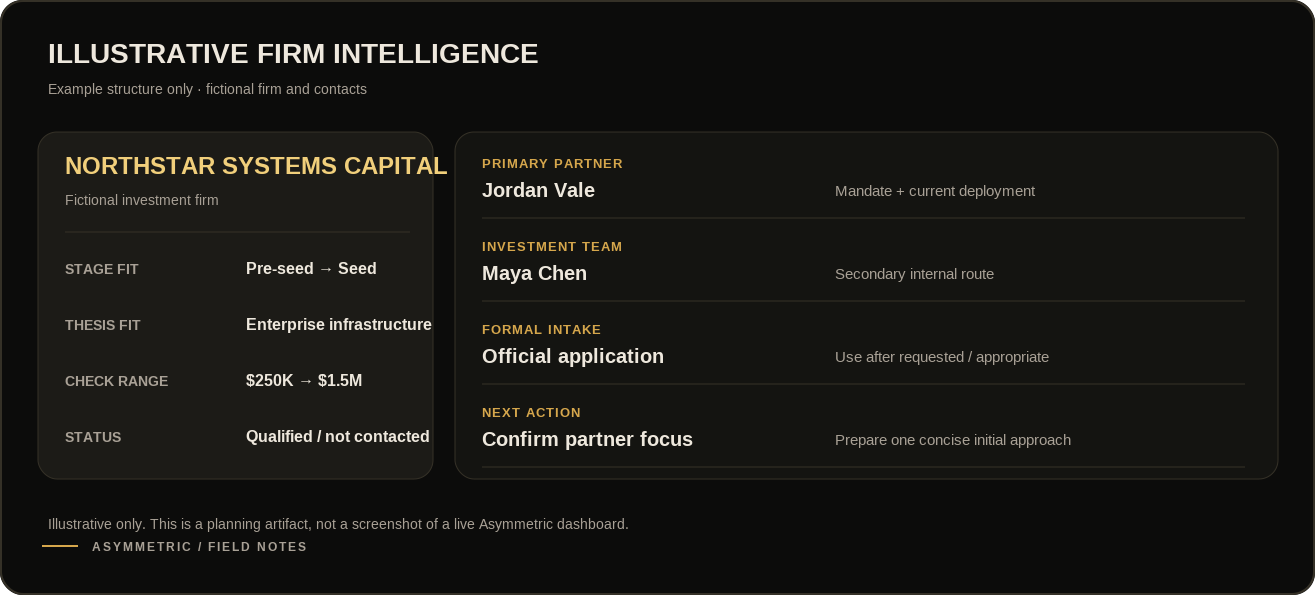
Then I use the response to determine the next route. A partner referral changes the context of the application. An associate introduction may replace the need to contact a second partner. A clear pass should be respected. A timing objection can lead to a later traction update, not daily reminders.
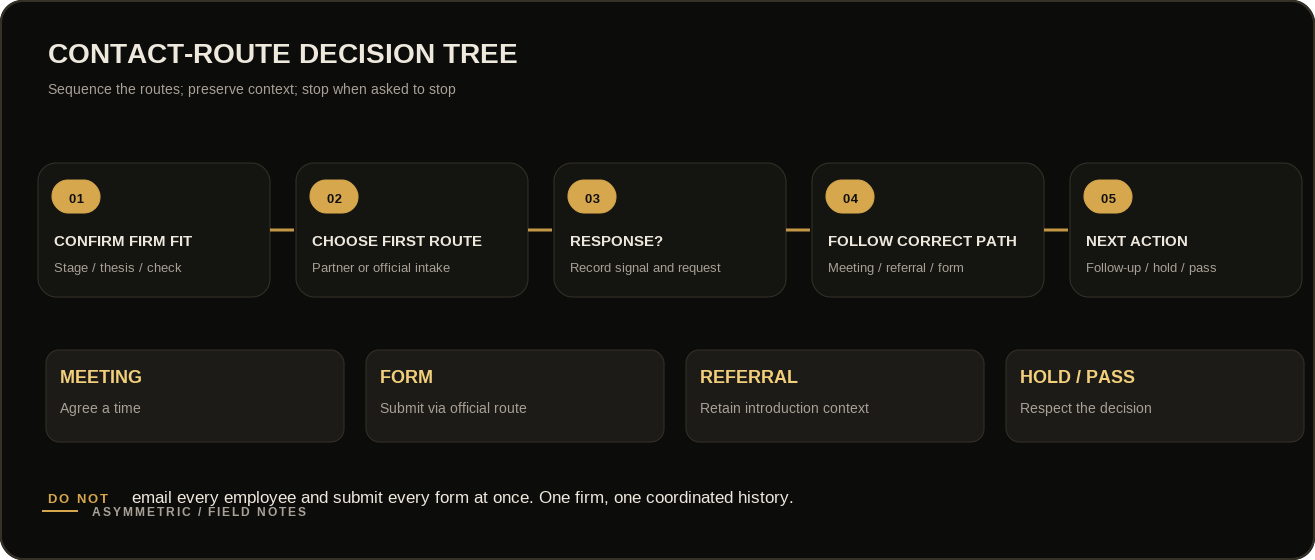
The underlying data can be held in a spreadsheet when you're starting. You don't need complicated software. But you do need a single source of truth. Otherwise one founder emails a partner while another sends the same deck to a general inbox and a third asks for a warm introduction, all without knowing the firm is already reviewing the company. That's not persistence. That's poor account management.
Here's the operating checklist I actually care about:
- Qualification: Stage, thesis, check range, geography, conflicts, recent activity.
- Route: Partner, investment-team member, official inbox, application, introduction, or event connection.
- Evidence: Why this route is legitimate and the date the source was checked.
- Message: A short investment thesis tied to this investor's reason to care.
- Status: Not contacted, outreach sent, engaged, materials requested, formal review, held, passed.
- Next action: A single owner, clear trigger, and reasonable follow-up date.
The strongest teams also keep a record of objections. If the fifth relevant investor says the company needs clearer retention proof, that is not just a follow-up task. It is intelligence that should affect the investment materials and the next wave of messaging.
A founder can absolutely build this themselves
For the first ten firms, I actually think founders should understand the mechanics personally. Research a firm, identify the actual route, write a message in normal human language, and log the result. You'll learn a lot about how the market sees your company.
The cost appears when the universe becomes fifty, a hundred, or several hundred qualified firms. Every company has a different partner, a formal route, a changing deployment window, a possible event connection, and a new response state. Managing that while running a startup becomes the second company I described at the beginning.
That's why I built a managed Investor Pipeline around the founder. It brings together firm qualification, route research, founder-approved outreach, applications where appropriate, follow-up, and iteration from real campaign responses. If the operational burden is already crowding out the business, you can schedule an Investor Pipeline strategy call with me and we'll see if the system makes sense for your round.
The part I want founders to remember is simpler than any software: don't send another pitch until you understand the actual way into that firm. More contacts are not a strategy. A researched route, a relevant thesis, and one well-managed next step are.
Methodology: campaign percentages referenced here are historical Asymmetric investor-outreach observations through November 2026. They are descriptive cohort results, not controlled experiments or predictions of fundraising outcomes. Investor workflow examples are summarized without private correspondence or identifying client details.