“What subject line gets venture partners to open an email?” Founders ask that a lot, and I get why. Investor inboxes are crowded, the stakes feel high, and the subject line is the only thing you can control before the investor decides whether to look. It's tempting to search for the one phrase that reliably breaks through.
I haven't found a magic phrase. What I have found is that different subject lines put different investment signals in front of the reader. Some signal round momentum. Others communicate traction. Others frame an economic problem in a way that makes the category worth a second look. The best signal depends on what is true about the company and what the specific investor values.
The subject is also only the opening move. We have historical campaigns where two emails used the same subject line but produced very different reply rates because the body and ask were different. That alone should make founders skeptical of advice promising a universal subject-line winner.

Three signals I would test first
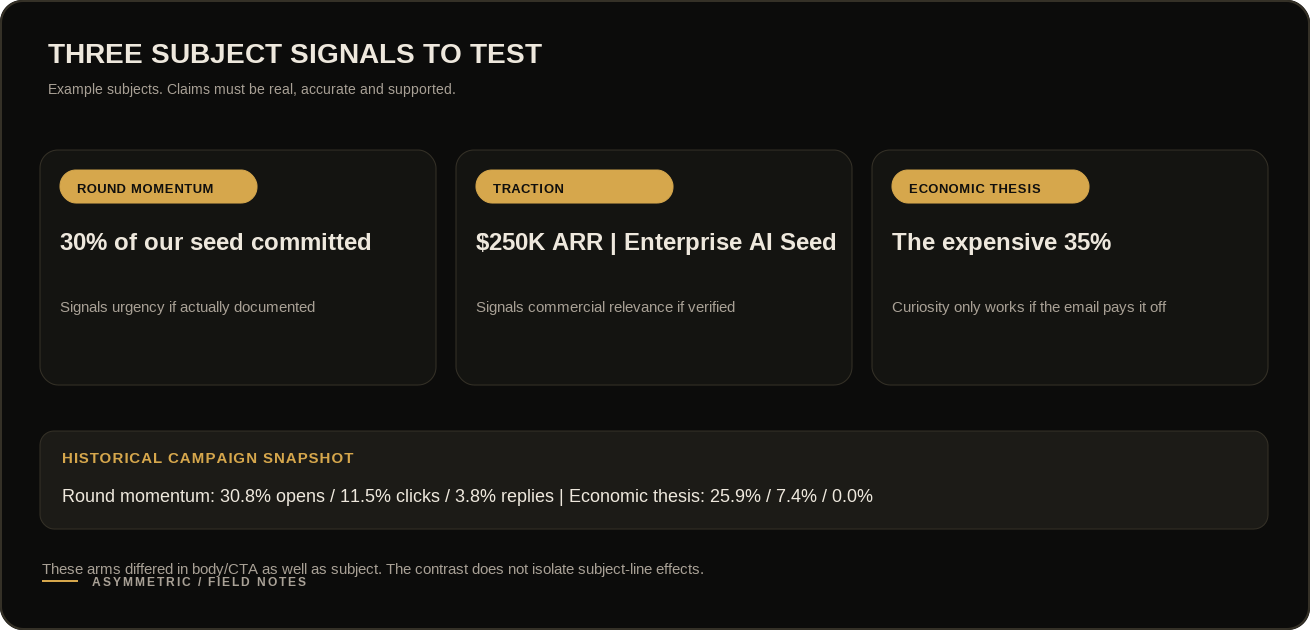
Round momentum. Example: 30% of our seed committed. A sentence like that can work because it supplies both a financing stage and a sense of momentum. But it is only appropriate when 30% is actually committed under a defensible definition. Verbal enthusiasm is not the same as committed capital. “Soft-circled” amounts should never quietly become closed commitments because the subject looks better.
Traction. Example: $250K ARR | Enterprise AI Seed. This is straightforward. It communicates current economic progress, category, and stage in a small amount of space. But the ARR must be real, current, and consistent with the deck. A seed investor who focuses on early technical breakthroughs may interpret that number differently from a fund that expects a certain amount of commercial proof.
Economic thesis or category curiosity. Example: The expensive 35%. This can attract attention when the email immediately explains the underlying cost or market inefficiency. It fails when the body doesn't pay off the curiosity. The subject can be provocative without being deceptive.
I wouldn't use all three for the same company by default. I'd choose the two or three that match the company's strongest provable reasons to care and the investor's actual mandate. If your startup is pre-revenue with an exceptional research breakthrough, don't force an ARR headline. If you're still looking for a lead, don't imply the round is already led.
What our round-momentum and economic-thesis cohorts showed
In one historical campaign snapshot, the round-momentum arm recorded a 30.8% open rate, 11.5% click rate, and 3.8% reply rate. A separate economic-thesis arm recorded 25.9% opens, 7.4% clicks, and 0.0% replies.
Those are real observed percentages from investor outreach, but they don't prove the subject line produced the difference. The campaign arms also differed in body and CTA. The recipient groups and delivery context can matter, too. The truthful conclusion is narrower: in that snapshot, the round-momentum package yielded a higher observed reply rate than the economic-thesis package.
A founder can still learn from that. Momentum can be a strong signal when it's credible, timely, and relevant to the fund. But if you want to know whether it's the subject doing the work, you need a cleaner experiment.
The experiment that changed how I talk about subject lines
We later observed two versions using the same subject but different body copy and calls to action. One version recorded a 13.3% reply rate. The other recorded 5.0%. The difference isn't tiny. Yet the subject line was held constant.
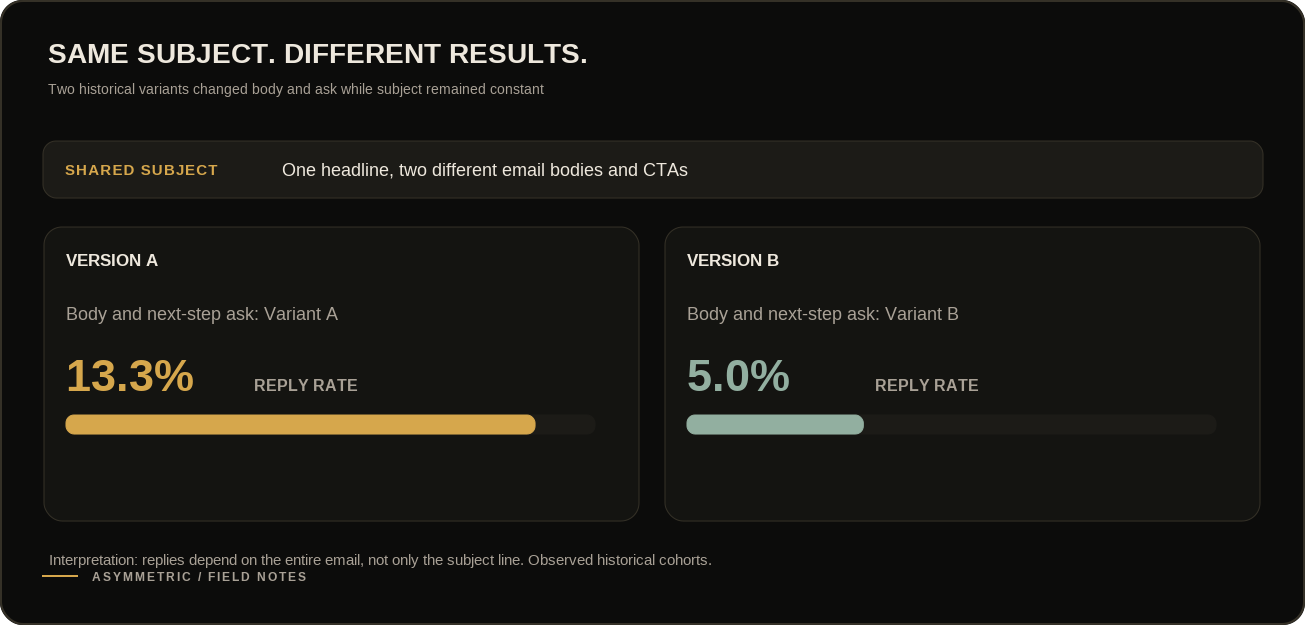
That doesn't prove the body caused the entire difference either. There can be audience and timing effects. But it does disprove a simplistic interpretation that you can predict performance from the headline alone. A good subject matched with a confused body or a burdensome ask can still lose the conversation.
An investor doesn't reply to the subject line. They reply to the whole proposition.
What I would test before sending another 100 VC pitches
I would begin with a group of funds that actually fit the company. Stage, thesis, check size and current deployment should already be checked. If half the recipients are bad fits, the subject test becomes a noisy measurement of targeting quality instead of message quality.
Next, I'd keep the sender setup and delivery conditions comparable. You can't responsibly compare performance from a warmed established domain to a brand-new domain and attribute the difference to copy. Sending windows, geographic time zones, and sender reputation all affect what gets observed.
Then I'd choose two subject lines with different signals, not arbitrary punctuation differences. For example, traction versus category thesis. I'd hold the message body and call to action constant so the headline is the main changing element. Each body should be true and appropriate under either subject. That is more disciplined than rewriting the entire email for every subject and then labeling it a subject-line experiment.
Finally, I'd decide what counts as success before sending. Opens are a diagnostic, not the goal. Replies are more meaningful, but I also want to distinguish positive investor replies from generic objections, declines or out-of-office messages. Qualified meetings actually held and substantive diligence requests can be more useful still, even when counts are small. A connection accepted on LinkedIn isn't a meeting. A link clicked isn't a meeting. A calendar link issued isn't necessarily a meeting held.
This is the same reason I think a first email should be only a few lines long. It gives the investor enough relevance to take one next step. If you want the full message framework, here's the investor-email teardown, including three different opening architectures and the observed reply rates from those campaigns.
A decision board you can build yourself
You don't need special reporting software. For each small cohort, record the investor-fit segment, sender conditions, subject, body version, ask, send window, opens, clicks, replies, positive replies, and meetings. Keep the definitions consistent. The denominator for an email reply rate is sent messages; a LinkedIn invitation acceptance rate uses invitations sent. Don't silently compare different metrics.
For historical comparison, we observed three messaging architectures with 0.0%, 3.3%, and 6.5% reply rates in their respective cohorts for traction-first, founder/team-first, and category-first messages. Again, those weren't identical controlled groups. They tell me that it is worth testing the proposition and not just the subject. I wouldn't promote the 6.5% observation as a guaranteed outcome for a new founder.
A clean dashboard might look simple: subject A versus subject B with open rate, reply rate, positive reply rate, and meetings. Then a note field answering, “What did we actually learn?” If the subject earned opens but the email didn't earn replies, the next experiment may be a stronger investment thesis or a smaller ask, not another clever headline.
The hidden variable is often investor fit
Imagine that the traction subject goes to a fund that is too late-stage for the company. It may get read and ignored because the opportunity is still outside mandate. A more intriguing category subject sent to a perfect seed investor could reply. Without matching the cohorts, you can learn the wrong lesson about writing.
This is why I treat email experiments as one layer in a firm-level pipeline. The six routes into a VC firm begins with qualification and routing before messaging. A good message should go to the right person through an appropriate contact path. No subject line compensates for a fund that does not write checks at your stage.
There is also the issue of precision. If you're going to claim revenue, growth velocity or percentage of a round committed, the figure should reconcile with your deck and any follow-up materials. Winning an open by exaggerating a metric is a terrible trade if the same detail undermines diligence later.
What I'd do next with a real fundraise
I'd choose a small number of unusually relevant firms, define two subject signals, hold the rest of the message stable, and make the ask easy to answer. After replies arrive, I'd identify which investors were qualified, what they objected to, and whether a different route inside the same fund is genuinely appropriate. Then I'd carry those lessons into the next wave.
If you're doing this yourself, that's already a meaningful upgrade. If you'd rather have us coordinate the research, routing, copy, follow-up, and measurement, you can schedule a strategy call about your Investor Pipeline. We can determine whether your company has the proof, timing, and investment thesis to make the process worthwhile.
The subject line deserves attention, but don't mistake it for the engine. The engine is a clear investment case delivered through a relevant route, with enough follow-through to turn a useful reply into a real conversation. That's what I'd fix before sending another hundred investor pitches.
Source: Asymmetric investor outreach observations through November 7, 2026. Campaign percentages describe historical cohorts. The message body, CTA and possibly recipient conditions differ across the comparisons described, so they do not isolate causal subject-line effects. Illustrative subjects use hypothetical facts and must be replaced with verified company information.